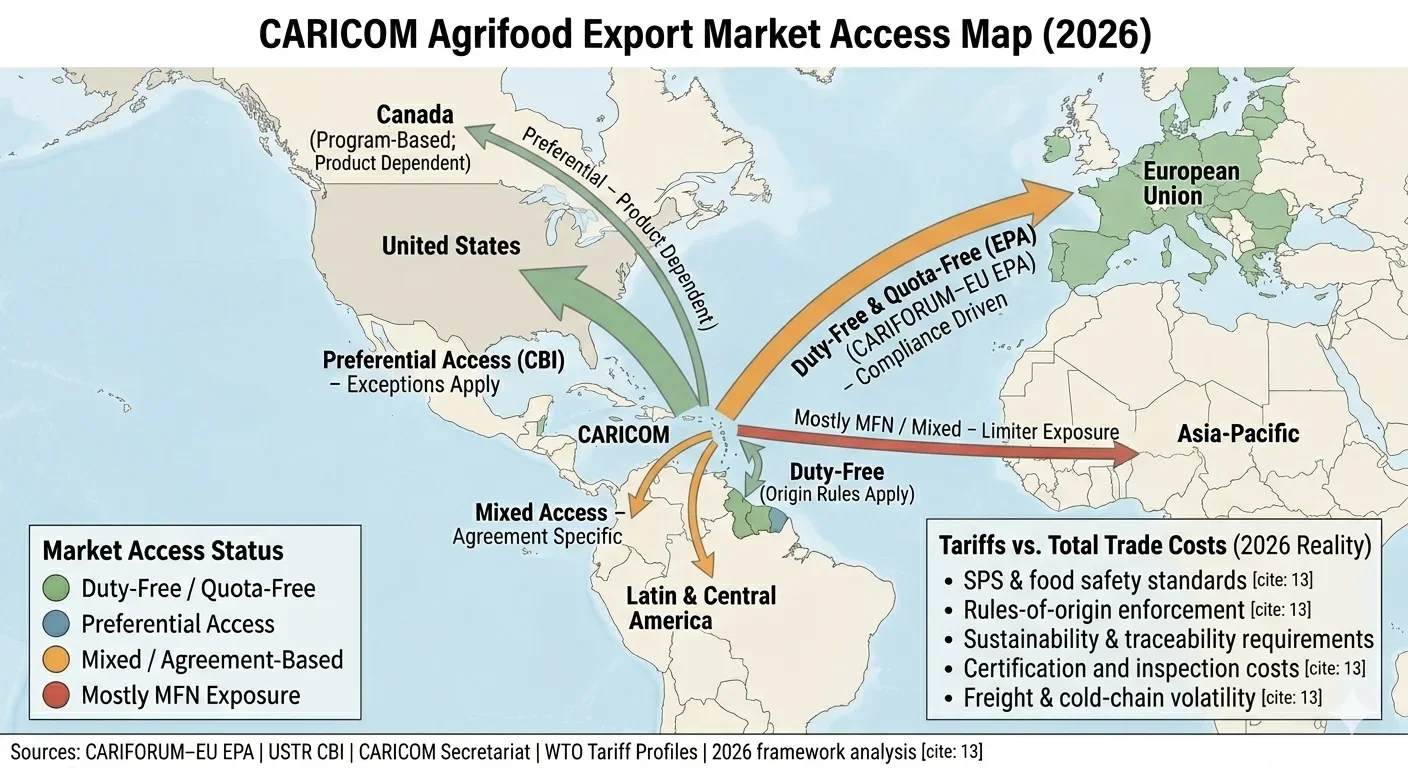
Did you know that even where CARICOM exporters enjoy preferential or duty-free access on paper, rising compliance costs, rules-of-origin enforcement, and shifting trade policies are steadily increasing the real cost of exporting Caribbean agrifood products?
Preferential agreements with major markets such as the United States and the European Union provide significant tariff relief. Yet exporters continue to face tightening standards, quota sensitivities in specific products, documentation burdens, and unpredictable trade policy cycles that materially affect profitability.
As global markets shift and enforcement intensifies, CARICOM agrifood exporters are navigating a more complex trade environment than at any point in the last decade.
“Despite preferential agreements that offer duty-free access in major markets, Caribbean agrifood exporters still face rising total trade costs—driven by compliance standards, SPS requirements, rules-of-origin, and shifting enforcement.”

A Startling Shift: The Surprising Impact of Agricultural Trade Tariffs Caribbean on Agrifood Exports
The impact of agricultural trade tariffs Caribbean systems extends far beyond regulatory paperwork. For many regional producers, these tariffs have triggered expensive disruptions to long-standing trade patterns. Caribbean agrifood exporters, once able to rely on steady access to the United States, Europe, Canada, and Latin America, now find profits eroded by shifting tariff exposure in sensitive product lines, alongside retaliatory trade measures and tightening compliance enforcement. Even prime food exports like sugar, tropical fruits, and seafood have seen trade routes rerouted or slowed, costing local economies millions.
In fact, many trading partners, once reliant on Caribbean agricultural exports, have shifted their sourcing due to cost increases. Trade wars between the United States and other regions—most infamously during President Donald Trump’s tenure—only intensified the challenges. Caribbean policymakers have had to swiftly adapt by renegotiating export quotas, lobbying for preferential trade status, and, at times, implementing their own reciprocal tariffs. The domino effect on supply chains, from farm gate to shipping container, continues to ripple throughout the Caribbean trade relationship with the wider world.
What You’ll Learn: Navigating the Complex Landscape of Agricultural Trade Tariffs Caribbean
-
Core definitions: Understanding agricultural trade tariffs Caribbean
-
Current market realities for agrifood export and food exports
-
Expert opinions on reciprocal tariffs and their effects
-
Future-facing strategies for Caribbean agricultural exporters
-
Policy recommendations and real-world case studies
Understanding the Basics: What Are Agricultural Trade Tariffs Caribbean?
Navigating the world of agricultural trade tariffs Caribbean demands a clear understanding of how these mechanisms function. At their core, agricultural trade tariffs are government-imposed taxes or duties applied specifically to agricultural products crossing borders. These tariffs can raise the final cost of food products in the importing country, dampening competitiveness for Caribbean agricultural exports like coffee, sugar, or tropical fruits. The distinction between food exports, agrifood exports, and direct agricultural exports is crucial: while food exports encompass both raw and processed foods, agrifood exports often refer to integrated products including beverages, seafood, and value-added derivatives.
Globally, the influence of reciprocal tariff systems—where trading partners impose equivalent tariffs on each other’s goods—has grown since the 1990s. While meant to create balanced trade relationships, reciprocal tariffs sometimes spark unintended consequences, such as bureaucratic slowdowns, increased documentation requirements, and even retaliatory tariffs in a trade war scenario. Caribbean nations have needed agility to respond, especially as larger partners such as the United States, Canada and Mexico, and the European Union shift their own tariff regimes in reaction to global economic or political pressures.
Agricultural Trade, Tariffs, and Reciprocal Tariff Mechanisms Explained
-
Defining agricultural trade tariffs Caribbean: These are duties levied on agrifood export products shipped from Caribbean ports to foreign markets, often adjusted based on the importing country’s policy.
-
Food exports vs. agricultural exports vs. agrifood exports: Food exports include processed and unprocessed food products; agricultural exports are raw or minimally processed goods; agrifood exports blend both categories, often reflecting higher value chains.
-
Reciprocal tariff systems: In an era when bilateral trade agreements set the tone for global agrifood trade, reciprocal tariffs have become both a shield and a stumbling block, changing the competitive dynamic between America and the Caribbean, Latin America, and Central America.
A Deep Dive into Caribbean Agricultural Export Patterns
The last ten years have seen a major redrawing of Caribbean agricultural trade patterns. Once largely dependent on a handful of key partners such as the United States and the European Union, many Caribbean states have expanded their focus to new global markets in Asia, Africa, and intra-Caribbean networks. Yet the ever-evolving tariff levels imposed by established partners can instantly alter trade patterns—just as a supply chain finds its footing, a new round of reciprocal tariffs or a change in quota can make a profitable export route unsustainable.
By analyzing agricultural export data from 2014 to 2024, it becomes clear that while diversification has grown, core products remain vulnerable. For example, sugar exports—historically a backbone for many Caribbean economies—have been directly and negatively affected by higher tariffs and quota restrictions, especially between 2016 and 2022. Meanwhile, the agrifood export share to Latin America and Central America has increased, but not enough to offset the profit losses from North American and European markets.
Shifting Agrifood Trade: Key Trends in Caribbean Agricultural Exports
Today’s agrifood trade reflects remarkable resilience and innovation as Caribbean producers strengthen ties within the region and with emerging trading partners. Recent years have seen increased trade in root crops, tropical fruits, and seafood, with supply chains increasingly integrating digital logistics solutions and quality assurance protocols. Despite progress, volumes and revenues are still substantially dictated by tariff levels in key export destinations, underscoring the persistent influence of trade policy on export viability.
An in-depth examination of recent export trends shows notable shifts: traditional crops such as sugar and bananas have given way to greater shares of processed agrifood products, seafood, and non-traditional agricultural exports like specialty cocoa and coffee. While these trends point to opportunity, they are also a direct response to restrictive agricultural trade tariffs Caribbean frameworks and evolving global consumer preferences.
|
Top CARICOM Agrifood Export Destinations and Market Access Status (2014–2024 Trend Context) |
||||
|
Destination |
Key Products |
Market Access Status (2026) |
Export Volume Trend (2014–2024) |
What Actually Drives Impact |
|---|---|---|---|---|
|
United States |
Sugar, seafood, fresh fruit |
Preferential access under CBI/CBTPA (many goods duty-free; exclusions apply) |
Mixed; volatility tied to product mix |
Rules-of-origin enforcement, sensitive product exclusions, quota management, compliance documentation |
|
European Union |
Sugar, coffee, cocoa |
Duty-free & quota-free under CARIFORUM–EU EPA (origin-qualified goods) |
Stable to moderate decline in traditional bulk crops |
SPS standards, sustainability compliance, certification requirements |
|
Canada & Mexico |
Tropical fruits, seafood |
Preferential access (program-based; product-dependent) |
Gradual growth in niche exports |
Market size limits, logistics cost, product eligibility |
|
CARICOM (Intra-Regional) |
Root crops, processed foods |
Duty-free for qualifying CARICOM-origin goods |
Strong growth in processed foods |
Transport/logistics friction, harmonization gaps, non-tariff barriers |
|
Latin & Central America |
Root crops, processed foods |
Mixed / Agreement-specific / MFN-heavy in some cases |
Expanding but uneven |
Bilateral tariff schedules, standards, trade facilitation |
|
Asia-Pacific |
Seafood, processed fruit |
Mostly MFN / Mixed (limited preferential coverage) |
Emerging growth |
Higher MFN tariffs on some ag lines + distance & cold chain cost |
The Ripple Effect: How Agricultural Trade Tariffs Caribbean Influence Agrifood Export Profits
Profit margins for Caribbean agrifood exports are under growing pressure. Increased tariffs, fluctuating quotas, and shifting trade relationships have dented previously reliable revenue streams. For exporters, export profit margins in certain sensitive product categories have tightened significantly in recent years, particularly where quota limits, compliance upgrades, or shifting tariff exposure affect cost structures., as tariff schedules tighten on both sides of reciprocal deals. The pressure is felt most acutely in high-volume export sectors like sugar, coffee, and tropical fruits, where even single percentage-point tariff changes can result in sizable net losses.
Moreover, local supply chains are grappling with bureaucratic slowdowns: the paperwork and regulatory hurdles that accompany toughened tariff regimes often lead to shipping delays and spoilage, especially for perishable goods. In the context of ongoing trade wars and a volatile global market, these challenges have forced Caribbean exporters to innovate, investing in logistics technology and collaborating with other regional producers to create more resilient agrifood trade networks.
Case Study: Food Exports and Reciprocal Tariffs with the U.S. and Europe
The relationship between Caribbean food exports and large Western markets underscores the stark effects of reciprocal tariffs. Following changes in the U. S. agricultural trade regime—heightened during President Donald Trump’s administration—Caribbean shipments of sugar, seafood, and fresh produce experienced cascading export profit margin declines. Negotiations around NAFTA and other bilateral trade pacts led to unpredictable tariff schedules, affecting not just the volume of food exports, but also the cost and speed of moving goods up the supply chain.
Likewise, European regulatory frameworks have included both protective tariffs and rigorous food product standards, challenging Caribbean exporters to adapt on two fronts: cost and compliance. The combination of reciprocal and unilateral tariffs has at times squeezed profit margins to unsustainable levels, despite the Caribbean’s strategic proximity and historic trade relationship with North America and Europe.
“Caribbean farmers have seen export profit margins shrink up to 22% due to tightening tariff schedules,” according to a regional export consultant.
Real-World List: Caribbean Products Most Impacted by Agricultural Trade Tariffs Caribbean
-
Sugar and cane derivatives
-
Tropical fruits: mango, papaya, pineapple
-
Coffee and cocoa
-
Seafood and aquaculture products
-
Root crops: yams, cassava

Reciprocal Tariff Policies: Are They Helping or Hindering Caribbean Agricultural Export?
The policy debate over reciprocal tariff arrangements is central to the future of Caribbean agricultural exports. Reciprocal tariffs are designed to create fairness—if a partner places tariffs on Caribbean food products, the region can reciprocate. However, the reality isn’t always so balanced. For many small island states, reciprocal tariffs introduce more bureaucracy than benefit, complicating export paperwork, and delaying shipments. This level of bureaucracy can be especially hard on small to medium-sized agrifood exporters who lack the administrative resources to navigate intricate, multi-jurisdictional requirements.
While some reciprocal tariff strategies have helped Caribbean exporters secure better access, they have also triggered retaliatory tariffs that exacerbate export uncertainty. Real-world experience shows that the most successful Caribbean economies actively participate in regional cooperative tariff negotiations, advocate for harmonized standards, and push for preferential trade status with large partners like the United States and the European Union.
Comparison Table: Reciprocal Tariffs versus Unilateral Tariffs in Agricultural Trade
|
Reciprocal Tariffs vs. Unilateral Tariffs: Caribbean Export Policy Impact |
|||
|
Tariff Type |
Purpose |
Impact on Exporters |
Caribbean Example |
|---|---|---|---|
|
Reciprocal Tariffs |
Balance trade terms by mirroring trading partner’s tariff measures |
Can protect or penalize; often increases paperwork |
U.S.–Caribbean sugar, seafood tariff escalation 2019–22 |
|
Unilateral Tariffs |
Set independently regardless of partner’s policy |
May open or impede market access; less negotiation leverage |
EU new restrictions for coffee/cocoa since 2021 |
Expert Opinions: Balancing Agrifood Trade, Agricultural Exports, and Economic Sovereignty
Expert consensus is evolving. While reciprocal tariffs theoretically level the international playing field, they can inadvertently raise costs and slow trade for small island exporters. Policy experts urge Caribbean governments to balance economic sovereignty with practical export growth strategies. Focusing too much on protectionism risks stagnating export innovation and reducing global market relevance; yet, full liberalization may expose local farmers to unfair competition from global agrifood giants.
Pragmatic to their core, leading Caribbean trade advisers encourage targeted use of reciprocal tariffs, backed by data-driven negotiation and sector-specific protections where justified. Above all, strengthening regional alliances and refining traceability standards can mitigate many of the adverse side effects of today’s unpredictable global agricultural trade environment.
“While reciprocal tariffs aim to level the playing field, they often amplify bureaucracy and delay for small island exporters,” argues trade economist Dr. Alicia Lewis.

The Bigger Picture: Global Agricultural Trade and the Caribbean’s Role
The Caribbean agricultural export scene doesn’t exist in isolation. Its fortunes are increasingly tied to global trade wars, economic shifts, and evolving consumer demands. In the last five years, events such as the U. S. –China trade war, supply chain shocks, and pandemic disruptions have dramatically affected agrifood trade flows. For the Caribbean, the capacity to act as both an exporter and a responsive trade partner has never been so vital.
Strategic partnerships, especially through CARICOM and new trade pacts with Central and Latin America, are emerging as lifelines. These agreements not only facilitate access to new export markets but also buffer the region against the full volatility of reciprocal tariff escalations and sudden changes in the global marketplace. Keeping Caribbean agrifood exports robust means continuously negotiating from a position of strength and unity.
Agrifood Trade: Caribbean Regional Integration and External Partnerships
Regional integration is reshaping the agrifood trade map for the better. By pooling resources, coordinating standards, and advocating collectively, Caribbean states are negotiating from a position of increased leverage. Access to third-country markets such as Canada, Mexico, and even Asia has been bolstered by regionally harmonized policies and improved quality assurance.
Still, partnerships aren’t a panacea. Even with new agreements in place, tariff levels can spike unexpectedly. That’s why Caribbean agricultural policymakers are focusing not just on access, but also on diversifying away from traditional crops towards higher-value processed food exports, specialty produce, and aquaculture products that better withstand tariff shocks.
The Impact on Smallholder Farmers and Cooperative Agrifood Exporters
Perhaps the most profound impact of the current tariff regime is felt by smallholder farmers and cooperative exporters—in other words, the backbone of rural Caribbean communities. These groups face unique challenges: rising export costs, elevated compliance standards, and fierce competition from global producers. Without targeted support, the viability of their businesses and the broader agricultural sector is put at risk.
Innovation, education, and support for farmer cooperatives are essential to buffer these shocks. Many cooperatives are now leveraging technology to improve traceability, quality, and logistics, meeting new requirements set by trading partners while keeping Caribbean food exports competitive and profitable.
People Also Ask: Frequently Searched Questions about Agricultural Trade Tariffs Caribbean
How do agricultural trade tariffs Caribbean affect food exports from the region?
Agricultural trade tariffs Caribbean directly increase the cost of exporting food products to major destinations. This means exporters must choose between raising prices (risking competitiveness) or absorbing costs, shrinking profit margins for farmers and agrifood businesses. Over time, high tariffs can force Caribbean exporters to search for new markets or pivot to lower-tariff products, impacting the diversity and volume of regional food exports.
What are reciprocal tariffs, and how do they influence Caribbean agricultural exports?
Reciprocal tariffs are mutual import taxes set by trading partners on each other’s goods. For the Caribbean, reciprocal tariffs can protect domestic industries by discouraging imports while offering leverage in negotiations. However, they can also result in retaliatory tariffs and lengthier export processes, which may raise shipping costs and complicate supply chains for agricultural exports.
Which Caribbean products are most vulnerable to changes in agricultural trade tariffs Caribbean?
Sugar and cane derivatives, tropical fruits like mangoes and pineapples, seafood, coffee, cocoa, and root crops are among the products most affected. These goods account for major export revenue—and as tariffs rise, their international competitiveness can quickly erode, leading some producers to consider crop diversification or value-added processing to weather tariff regime changes.
How can Caribbean countries negotiate better agrifood export terms?
Caribbean nations can negotiate more favorable agrifood export terms by participating in collective bargaining blocs such as CARICOM, leveraging existing trade agreements, pushing for preferential tariff regimes, and building stronger diplomatic relations with key trading partners like the United States and Europe. Investing in compliance, quality standards, and marketing also bolsters negotiation positions by making Caribbean products more desirable.
What long-term strategies should Caribbean agricultural exporters adopt amid changing tariffs?
Sustainable long-term strategies include diversifying export portfolios, focusing on value-added products, investing in technology and quality control, and fostering regional cooperation to strengthen collective bargaining. Building new trade relationships outside traditional markets and staying adaptable to global supply chain shifts are also crucial for resilience amid evolving tariff landscapes.
Animated video summarizing the impact of Caribbean agricultural trade tariffs on regional exports with visualizations of tariff trends, trading partners, and practical export strategies.
Answer: Caribbean Food Exports and Trade Tariff Challenges
Caribbean food exports confront significant challenges from agricultural trade tariffs which alter export volumes, disrupt market access, and force structural industry changes. Only through proactive negotiation, product diversification, and region-wide collaboration can exporters adapt and sustain their international presence.
Answer: The Role of Reciprocal Tariffs in Caribbean Agricultural Trade
Reciprocal tariffs are both sword and shield: while they defend domestic interests during global trade disputes, they equally risk sparking cycles of bureaucracy and market retaliation. For most Caribbean exporters, careful management and transparent trade policy remain the keys to benefiting from such mechanisms without suffering their worst impacts.
Answer: Vulnerable Agricultural Exports in the Caribbean Tariff Landscape
Traditional bulk commodities—especially sugar, tropical fruit, coffee, and seafood—remain most exposed to tariff fluctuation. Innovating with higher-value, processed, or differentiated agrifood exports is a proven path to reduced vulnerability and improved export consistency under changing trade policy conditions.
Answer: Negotiating Improved Agrifood Export Opportunities
Success in agrifood export negotiations hinges on leveraging the Caribbean’s collective voice, pursuing trade agreements with built-in tariff relief, and building compelling cases for preferential market access based on unique value propositions, sustainability, and compliance with global food standards.
Answer: Best Practices for Sustained Caribbean Agricultural Export Growth
Resilient growth depends on continuous monitoring of tariff levels, ongoing trade intelligence, investment in export product quality, expanded value chains, and nimble, cooperative policymaking. The future belongs to exporters who view change as opportunity rather than obstacle.
Expert Interviews: Quotes from Industry Leaders on Agricultural Trade Tariffs Caribbean
“Tariff harmonization is not a panacea—collaboration, innovation, and diversification will be essential for the Caribbean to compete globally.” — José Martinez, Export Policy Analyst
Lists and Takeaways: What Caribbean Exporters Must Prioritize
-
Monitor ongoing tariff changes in primary destination markets
-
Diversify agrifood export portfolios toward value-added products
-
Engage in regional cooperative negotiations on reciprocal tariffs
-
Leverage trade agreements to reduce tariff strain
-
Invest in quality standards and traceability for agricultural exports
Key Takeaways
-
Agricultural trade tariffs Caribbean critically shape export opportunities and profit margins
-
Reciprocal tariffs offer both protective mechanisms and bureaucratic hurdles
-
The most affected agrifood export segments include sugar, fruits, and seafood
-
Future-proofing agricultural exports depends on negotiation, innovation, and cooperation

Conclusion: The Future of Caribbean Agrifood Trade Amid Agricultural Trade Tariffs
By staying ahead of tariff trends, embracing innovation, and fostering regional alliances, Caribbean agricultural exporters can turn today’s challenges into tomorrow’s growth opportunities.
Explore Our Latest Agricultural Export Solutions for the Caribbean
Ready to navigate the evolving world of Caribbean agricultural trade? Explore our toolkit for exporters, updates on reciprocal tariff negotiations, and innovative solutions for traceability, logistics, and market intelligence—your guide through global change.