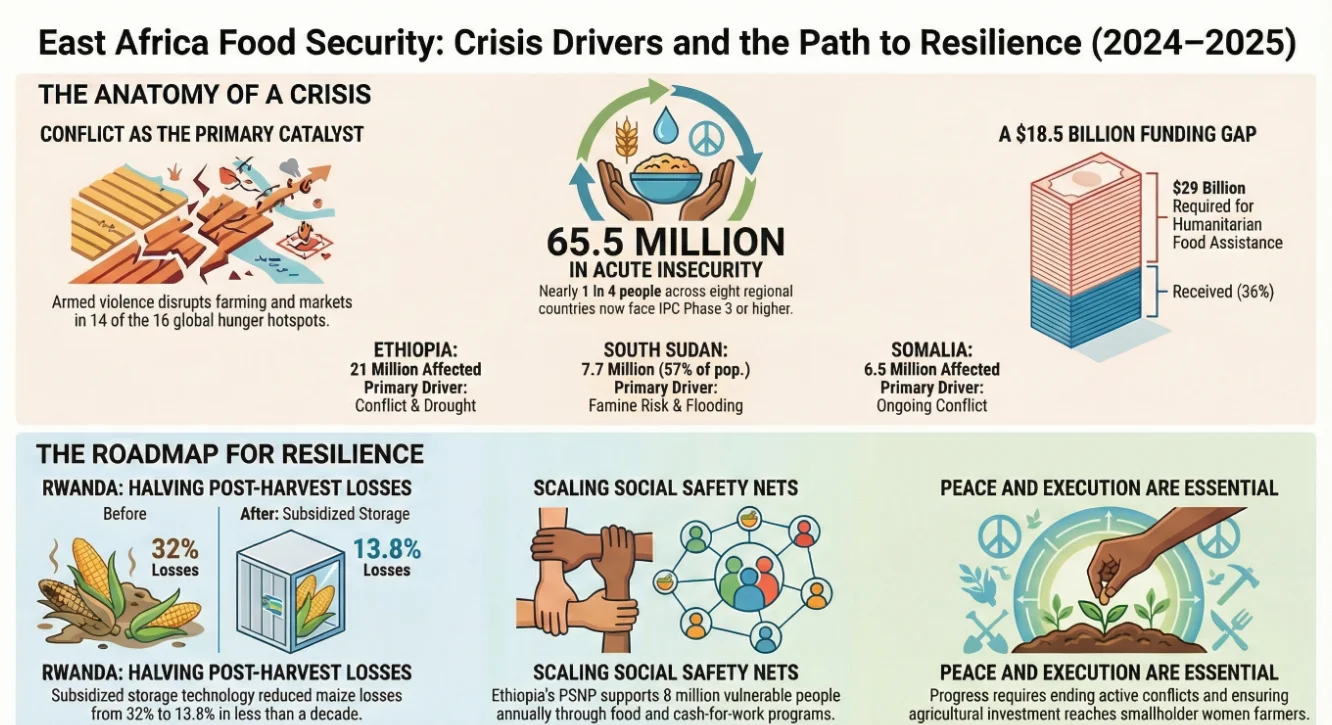
Across eight East African countries, 65.5 million people were assessed as facing acute food insecurity (IPC Phase 3 or above) during at least one period in 2024—an increase of 1.3 million from the previous year.¹ The drivers are not obscure: armed conflict, climate extremes, and economic shocks are converging in a region where acute hunger has risen sharply since 2019, now affecting roughly one quarter of the population in the most affected countries.
This analysis examines the scale of the crisis, where policy interventions have delivered measurable results, and the structural failures that continue to deepen food insecurity across the region.
The Scale of the Crisis
The most authoritative metric of acute food insecurity is the Integrated Food Security Phase Classification (IPC), which categorizes populations from Phase 1 (Minimal) to Phase 5 (Catastrophe/Famine). According to the 2025 Global Report on Food Crises (GRFC 2025), produced by the Global Network Against Food Crises (GNAFC), 65.5 million people across Burundi, Djibouti, Ethiopia, Kenya, Somalia, South Sudan, Sudan, and Uganda were assessed in IPC Phase 3 or above during 2024.¹
The crisis is unevenly distributed.
Sudan represents its most extreme manifestation. In 2024, the IPC Famine Review Committee confirmed famine conditions affecting more than 755,000 people—the third confirmed famine globally in 15 years.²
In South Sudan, approximately 7.7 million people—over half of the population—were projected to face IPC Phase 3 or above during the April–July 2025 lean season.³
In Somalia, between four and five million people—roughly one quarter of the population—required urgent food assistance in 2025.⁴
Child malnutrition compounds these figures. Recent UNICEF and WHO surveys estimate child stunting rates at approximately 37 percent in Ethiopia, 40 percent in Somalia, and above 30 percent in several neighboring states.⁵ These figures reflect structural nutritional deficits that extend beyond short-term food shocks.
The World Food Programme’s 2026 Global Outlook reports a roughly 20 percent increase in the number of people facing acute food insecurity globally since 2020—a trend driven primarily by conflict rather than harvest failure.⁶
What Is Driving the Crisis?

Conflict as the Primary Driver
Armed conflict remains the dominant cause of acute food insecurity in East Africa. The war in Sudan between the Sudanese Armed Forces and the Rapid Support Forces, which began in April 2023, has displaced more than 10 million people internally and externally, disrupting agricultural production and market access at national scale.⁷
Ethiopia’s Tigray conflict (2020–2022), though formally concluded under a peace agreement, severely degraded agricultural production and livestock assets in one of the country’s most productive regions.⁸ South Sudan has experienced recurrent displacement and localized violence since independence in 2011, preventing stable agricultural recovery.⁹
The FAO/WFP Hunger Hotspots report (2025 edition) identifies armed violence as the dominant driver in the majority of global food crisis contexts.¹⁰ Conflict disrupts planting cycles, destroys infrastructure, blocks humanitarian access, and fractures markets—effects that cannot be offset by agricultural policy alone.
Climate Extremes

Climate variability is the second major driver. The 2020–2023 drought across the Horn of Africa—the most severe in four decades—caused widespread livestock mortality and crop failure in Somalia, Ethiopia, and Kenya.¹¹ The subsequent El Niño cycle in late 2023 brought excessive rainfall that improved conditions in some areas but triggered destructive flooding in others.
In South Sudan, flooding in 2024 displaced hundreds of thousands and severed road access to humanitarian supplies.¹² FAO and WFP projections warn of renewed below-average rainfall risks for Somalia and Kenya in 2025–2026, alongside continued flood exposure in South Sudan.¹³
The region’s vulnerability is amplified by structural reliance on rain-fed agriculture and limited irrigation infrastructure.
Humanitarian Financing Constraints
A third emerging constraint is the sharp shortfall in humanitarian funding. As of late 2025, only approximately USD 10.5 billion of the USD 29 billion required for global humanitarian food security responses had been mobilized.¹⁴ In several hunger hotspot contexts, food assistance targets were reduced significantly due to budget constraints.
The Global Network Against Food Crises projects that humanitarian allocations to the food sector in crisis contexts could decline by up to 45 percent if donor commitments do not increase.¹⁵ Such reductions would translate directly into increased mortality and malnutrition.
Where Policy Has Delivered Results
Rwanda: Post-Harvest Loss Reduction
Rwanda’s Post-Harvest Handling and Storage (PHHS) program offers one of the region’s clearest examples of measurable policy success. Launched in 2010, the initiative subsidized hermetic storage technologies—including sealed bags and metal silos—at up to 75 percent of cost for smallholders.¹⁶
Maize post-harvest losses declined from approximately 32 percent to 16.4 percent by 2019, with further reductions reported in subsequent years.¹⁷ More recent Rwanda Agriculture Board data indicates grain losses below 15 percent in key commodities.¹⁸
However, high losses persist for perishable crops such as tomatoes and cassava, illustrating that commodity-specific interventions are required beyond grain systems.
Ethiopia’s Productive Safety Net Programme (PSNP)
Established in 2005, Ethiopia’s Productive Safety Net Programme supports approximately eight million vulnerable people annually through cash or food transfers linked to public works.¹⁹
Impact evaluations show improved food consumption outcomes when transfers are combined with agricultural support.²⁰ However, evidence on asset accumulation and long-term income gains is mixed, with some regional studies finding limited or no statistically significant effects in specific zones.²¹
The program faces a financing gap of approximately USD 195 million for the 2023–2024 period, resulting in reduced transfer duration for beneficiaries.²² Fiscal constraints following Ethiopia’s 2023 debt default have further limited domestic absorption capacity.
East African Community (EAC) Coordination
The East African Community has adopted regional agricultural coordination frameworks, including its Agricultural and Rural Development Policy and Vision 2050 strategy. In March 2025, it launched the USD 12.5 million ENSURE project to strengthen agricultural extension services.²³
However, institutional constraints limit implementation. Member state arrears to the EAC budget exceeded USD 35 million as of 2025, and staffing shortages have constrained operational capacity.²⁴ While intra-EAC trade increased by 27 percent between mid-2024 and mid-2025, reaching USD 18 billion, institutional fiscal instability undermines coordinated food security response.²⁵
Structural Failures
Across East Africa, policy frameworks exist. CAADP commits governments to allocating 10 percent of national budgets to agriculture; national food security action plans are widespread. Yet consistent underfunding and weak accountability mechanisms hinder implementation.
Women comprise the majority of the agricultural labor force in several East African countries, yet face persistent barriers to land ownership, credit access, and extension services.²⁶ Youth access to agricultural finance remains similarly constrained.
Early warning systems—including FEWS NET and IGAD’s Climate Prediction and Applications Centre (ICPAC)—provide reliable projections.²⁷ The 2024 famine in Sudan was preceded by months of warnings. Data capacity is not the binding constraint; political will and financing are.
Here’s the thing, East Africa’s food security crisis is not primarily a deficit of agricultural knowledge or technology. Rwanda’s post-harvest reforms demonstrate that targeted interventions can deliver measurable national-scale impact. Regional trade integration continues to expand. Early warning systems function.
The binding constraints are conflict, declining humanitarian financing, and institutional execution gaps. Without sustained peace, adequate funding, and governance reform, agricultural capital will remain concentrated in low-risk export sectors rather than smallholder systems where hunger is most acute.
The 65.5 million people facing acute food insecurity in 2024 are not statistical abstractions. They represent farming households displaced from land, parents reducing meal frequency, and children whose nutritional deficits may permanently constrain lifetime productivity.
The architecture for response exists. What remains uncertain is whether political leadership and financing will align at a scale proportionate to need.
Frequently Asked Questions
What is food security policy in East Africa?
Food security policy in East Africa refers to the set of national and regional strategies designed to ensure that populations have reliable access to sufficient, safe, and nutritious food. These policies typically include agricultural investment plans, social protection programs, climate adaptation strategies, trade coordination frameworks, and emergency response systems. At the regional level, institutions such as the Intergovernmental Authority on Development (IGAD) and the East African Community (EAC) coordinate cross-border food security planning. Many East African governments align their strategies with the Comprehensive Africa Agriculture Development Programme (CAADP), which encourages allocating at least 10 percent of national budgets to agriculture. However, implementation gaps, conflict, climate shocks, and financing constraints often limit the effectiveness of these policies in practice.
What is IPC Phase 3?
IPC Phase 3 refers to “Crisis” level food insecurity under the Integrated Food Security Phase Classification (IPC) system. The IPC is a globally recognized framework used by governments, the United Nations, and humanitarian agencies to assess the severity of food insecurity. Phase 3 indicates that households either face significant food consumption gaps or are only able to meet minimum food needs by depleting essential livelihood assets. At this stage, acute malnutrition rates typically rise, and emergency interventions are required to prevent deterioration into Phase 4 (Emergency) or Phase 5 (Catastrophe/Famine). IPC classifications are based on technical analysis of food access, nutrition indicators, livelihood changes, and mortality data.
Which East African countries face the worst food insecurity?
As of the 2024–2025 assessment period, Sudan, South Sudan, Somalia, and Ethiopia face the most severe levels of acute food insecurity in East Africa. Sudan experienced confirmed famine conditions in 2024 in areas affected by armed conflict. South Sudan continues to see more than half of its population projected in IPC Phase 3 or above during lean seasons. Somalia remains highly vulnerable due to conflict and recurrent drought, while Ethiopia faces localized severe food insecurity linked to past conflict and climate shocks. Kenya and Uganda also experience food insecurity, particularly in arid and semi-arid regions, but at comparatively lower national severity levels.
How does conflict affect agriculture?
Conflict affects agriculture by disrupting every stage of food production and distribution. Armed violence displaces farming households from productive land, destroys irrigation systems and storage infrastructure, interrupts planting cycles, and blocks access to markets. Livestock may be looted or lost, and supply chains become fragmented due to road insecurity. In conflict zones, humanitarian access is often restricted, limiting emergency food assistance. Over time, repeated displacement erodes household assets, reduces agricultural investment, and weakens national food systems. Evidence from Sudan, South Sudan, and Ethiopia shows that conflict-driven displacement has significantly reduced crop output and livestock productivity, making conflict the leading driver of acute food insecurity in the region.
What role does climate change play in East Africa’s food crisis?
Climate change intensifies food insecurity in East Africa by increasing the frequency and severity of droughts, floods, and rainfall variability. The 2020–2023 Horn of Africa drought—one of the most severe in four decades—caused widespread livestock deaths and crop failure across Somalia, Ethiopia, and Kenya. Subsequent extreme rainfall events linked to El Niño brought destructive flooding in parts of South Sudan and Kenya. Because most smallholder farmers in East Africa rely on rain-fed agriculture, climate shocks directly reduce yields and household income. Climate change does not act alone but compounds existing vulnerabilities, particularly in conflict-affected and low-irrigation areas.
How is humanitarian funding affecting food security?
Humanitarian funding plays a critical role in preventing acute food insecurity from escalating into famine. Emergency food assistance, cash transfers, nutrition programs, and agricultural support depend heavily on international donor financing. In recent years, global humanitarian appeals for food security have been significantly underfunded, forcing agencies to reduce beneficiary numbers or shorten assistance duration. When funding gaps widen, households facing IPC Phase 3 or above may receive less support, increasing the risk of malnutrition and mortality. Sustained and predictable financing is essential to stabilize vulnerable populations, particularly in conflict-affected contexts such as Sudan and South Sudan.
Endnotes
- Global Network Against Food Crises (GNAFC), Global Report on Food Crises 2025.
- IPC Famine Review Committee, Sudan Analysis 2024.
- IPC Global Dashboard, South Sudan Projection (April–July 2025).
- FEWS NET, Global Food Security Update, May 2025.
- UNICEF/WHO, Joint Child Malnutrition Estimates 2021–2023.
- World Food Programme, Global Outlook 2026.
- FAO/WFP, Hunger Hotspots, November 2024–May 2025.
- FAO Situation Reports, Ethiopia (2022–2024).
- WHO, Greater Horn of Africa Public Health Situation Analysis (2024).
- FAO/WFP, Hunger Hotspots, 2025 edition.
- FEWS NET, Global Food Security Update, May 2025.
- FAO/WFP, Hunger Hotspots, 2025 edition.
- Ibid.
- FAO/WFP Global Funding Update, 2025.
- GNAFC, Acute Food Insecurity Key Messages 2025.
- Rwanda Ministry of Agriculture (MINAGRI), PHHS Program Reports.
- PMC/NCBI, “Assessment of Factors Affecting Smallholder Maize Storage in Rwanda,” 2021.
- Rwanda Agriculture Board, Commodity Loss Data (2023).
- Climate Policy Initiative, PSNP Case Study; IFPRI documentation.
- Gilligan et al., Journal of Development Studies.
- Heliyon (2024); Food and Energy Security (2024).
- The New Humanitarian, March 2024.
- East African Community, ENSURE Project Launch, March 2025.
- East African Community Secretariat Budget Reports, 2025.
- East African Community Trade Statistics, 2025.
- EAC Youth in Agri-Food Systems Expo Report, December 2025.
- FEWS NET; ICPAC Regional Updates, 2025.